HardwareFor this job
By the Empty Vapes trade desk. Published 2026-08-21, last updated 2026-08-21. How we write these.
Airflow is the specification buyers argue about most and measure least. It is also the one a customer judges in the first second, before flavour or battery life get a chance to matter.
Draw resistance is how hard the user has to pull to move air through the device. Air enters somewhere near the base, passes the heated core, picks up vapour and leaves through the mouthpiece. Every narrow point on that route adds resistance, and the narrowest point dominates: widening a section that was never the restriction changes almost nothing.
Two terms describe the ends of the range. A tight draw resists the lungs and feels dense. An open draw moves more air for the same effort and dilutes the vapour into a larger volume. Neither is correct in the abstract. What matters is that the draw matches what your customer expects from the format, and that it is the same on the thousandth unit as on the first.
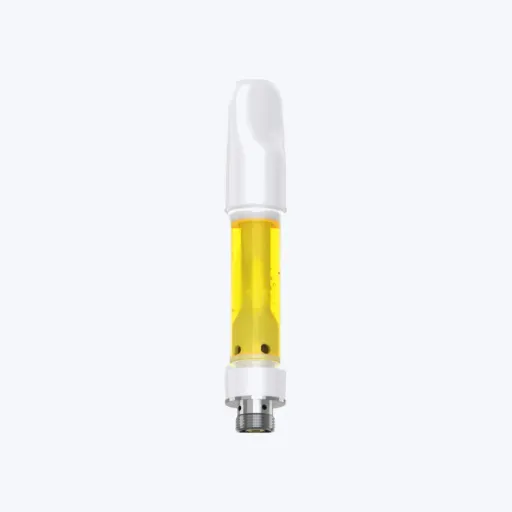
This is the most common and most expensive confusion in cartridge specification. Intake holes, sometimes called oil inlet holes or apertures, are the openings that let oil pass from the tank into the ceramic core. They are not part of the airpath. CCELL lists the aperture size of its TH2-EVO cartridge as 4 x D2 mm, and that number describes oil feeding, not breathing.
The two get confused because both are small holes near the base of the tank and both are quoted in millimetres. Widening the intake to fix a tight draw does not fix the draw. It floods the core with more oil than the coil can vaporise, which produces exactly the symptoms buyers then blame on airflow: gurgling, spitback, a wet mouthpiece and eventually leaks. Match the intake to the viscosity of your oil, as set out in intake hole size and intake for thick oil, and change the airpath if you want to change the draw.
| Dimension | Tighter draw | More open draw |
|---|---|---|
| Perceived vapour density | Denser, because the same vapour sits in less air | Thinner, because it is diluted into more air |
| Effort at the lips | Higher, closer to a cigarette | Lower, closer to a straw |
| Oil used per puff | Lower for a given puff length, so a tank lasts longer | Higher, which shortens the reported life of the same capacity |
| Condensation in the airpath | More, because slow-moving vapour has time to condense | Less, though the vapour arrives cooler |
| Clog sensitivity | Higher, because a small deposit is a large share of a small opening | Lower, but a wide path lets oil migrate up more easily |
| Behaviour with thick oil | Tolerant, since slower airflow suits a slower feed | Can outrun the wicking rate and taste burnt |
| Auto-draw reliability | Sensor triggers readily from the pressure drop | A weak pull may not trigger the sensor at all |
| Typical complaint when wrong | Blocked, no airflow, hard work | Airy, weak, tastes of nothing |
Airflow reaches the trade buyer as three separate problems that do not look related.
Consistency across a batch. Airflow variation comes from moulding and assembly, so it drifts as a tool wears or a fixture loosens. A sample drawn from one carton will not show it, because those units were made minutes apart. Draw across the run instead, as in the cartridge QC checklist.
Attribution. When a customer says a device is weak, the cause may be airflow, coil resistance, battery voltage or the oil. Perceived draw is airflow and vapour production combined, so the same cartridge on a higher-voltage battery reads as heavier without any change to the airpath. Fix the voltage before you compare hardware. The battery voltage guide covers the pairing.
The returns pattern. A tight batch produces complaints of blockage, an open batch produces complaints of weakness, and the shape of the complaint tells you which way the tool drifted before you have measured anything.
Stock 510 cartridges start from around 500 units with no container minimum, which makes it affordable to test two airflow variants before committing to a branded run of about 15 days. CE, RoHS, REACH and EU Battery Regulation documentation is available on request and WEEE support is available; the market registrations remain yours. See compliance.
Trade guidance for B2B buyers, not legal advice. We sell empty hardware only; you are responsible for the fill and for finished-product compliance in your market.
Browse the range in the shop, full specs, trade pricing after a free account, and CE and compliance docs on request.
Browse the catalogueGive us the hardware, the quantity and the market. We reply with a price, a specification and a lead time. A request for a quote is not an order.
Empty hardware only. No cannabinoids and no e-liquid. We sell to companies only.