HardwareFor this job
By the Empty Vapes trade desk. Published 2026-08-21, last updated 2026-08-21. How we write these.
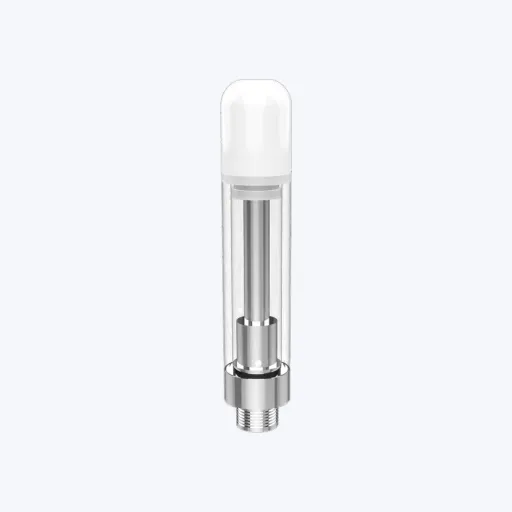
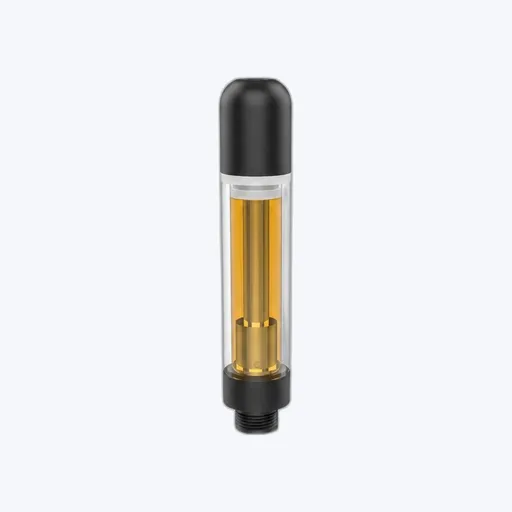
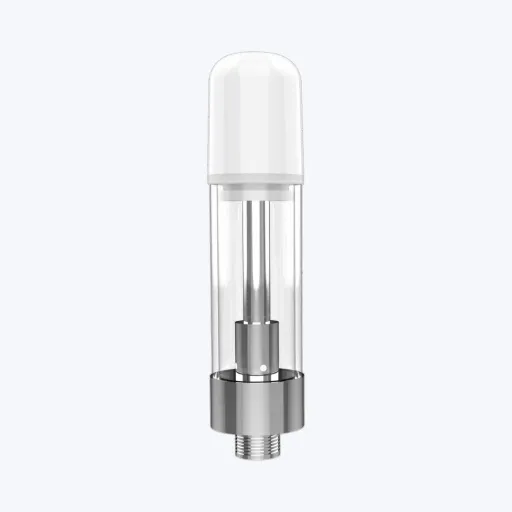
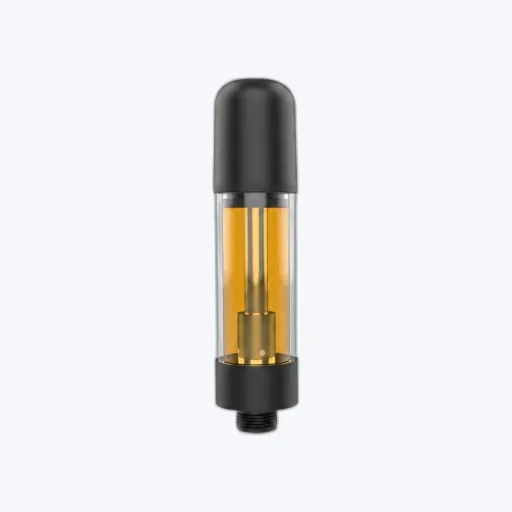
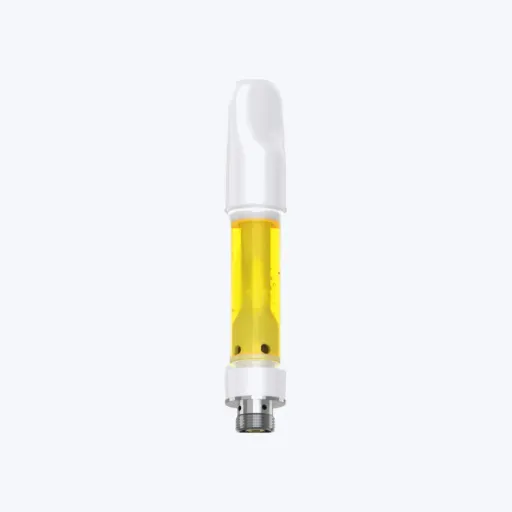
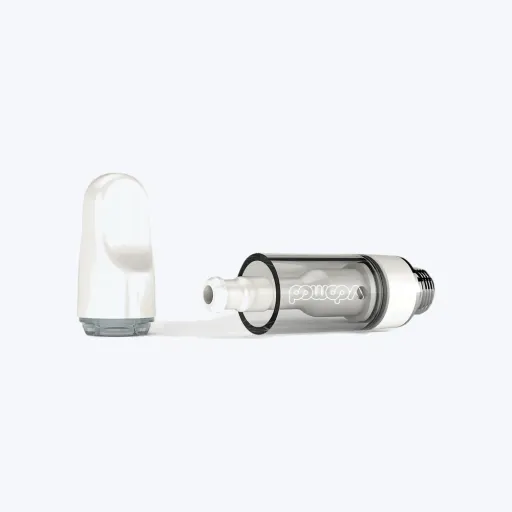
The mouthpiece is the only part of a cartridge the customer touches, and it is also the last few millimetres of the airpath. Shape, material and fitting method are three separate decisions, and only one of them is visible in a product photo.
Three jobs, and they pull against each other. It closes the top of the tank, so a poor fit is a leak path. It forms the final section of the airpath, so its internal bore adds to the draw resistance. And it rests against the lip, so it carries heat, comfort and most of the impression of quality a customer forms in the first second.
Internal bore is not the same as external shape, and this is where specifications go wrong. Two mouthpieces that photograph identically can be bored differently. CCELL states for its Flex platform that the mouthpiece internal structure differs by tank size even where the body is shared. Ask for the internal dimension rather than the silhouette.
One caution before the table. Flat and round describe a shape. Ceramic tip describes a material, and a ceramic tip can be flat or round. Catalogues list all three side by side as though they were points on one scale, and the table follows that convention because it is how buyers meet them.
| Flat (duckbill) | Round (bullet) | Ceramic tip | |
|---|---|---|---|
| What the name describes | A shape: wide and flattened at the tip | A shape: a narrow tapered cylinder | A material, in either shape |
| Feel at the lip | Broad contact, sits like a flat straw | Small contact patch, familiar to cigarette users | Depends on the shape chosen; the surface feels harder and denser |
| Draw character | Usually a wider bore, so more open unless restricted elsewhere | Usually a narrower bore, so tighter at the same intake | Set by the bore, not the material |
| Heat at the lip | Heat spreads across a wider area | Concentrated on a smaller area | Ceramic holds heat differently to plastic, so the tip warms more slowly and stays warm longer |
| Usual material | Moulded plastic or metal | Moulded plastic, metal or ceramic | Ceramic, sometimes with a metal collar |
| Condensation path | A wide bore spreads condensate over a larger surface | A narrow bore concentrates it, so the user notices | No material advantage; the bore geometry decides it |
| Branding surface | Largest flat face, easiest to print or etch | Curved and small, harder to brand cleanly | Takes a different decoration process to plastic, so often left plain |
| Relative cost | Lowest in moulded plastic | Low to mid, rising with metal | Highest of the three, and heavier per unit for freight |
| Handling risk | Flexible tips can deform in transit | Survives transit well, and marks show on gloss finishes | Chips if dropped, so reject rates on inspection tend to be higher |
Catalogue ranges make this explicit. CCELL lists mouthpiece material options for its TH2-EVO cartridge as ceramic, metal, plastic, biodegradable PLA and wood, and separately lists shape options as duckbill, bullet, hourglass and barrel. Treat those as two independent columns on your order form rather than one list of styles.
Whatever the material, ask for the food-contact declaration for the part that touches the lip. It is separate from the RoHS and REACH file, and it is the one most often missing.
The fitting method touches your filling line, and it is often settled by the hardware rather than by preference. CCELL lists its TH2-EVO with snap-fit or screw-on tops at 0.5 ml and 1 ml, and snap-fit only at 1.2 ml, so the capacity you pick can remove the choice.
Snap-fit wins on throughput. CCELL states that snap-fit mouthpieces on the Flex and TH2-EVO can be batch-capped 50 pieces at a time, and 18 at a time on its Mini Tank. A press that seats fifty caps in one stroke is a different operation from capping by hand. The cost is that a snapped cap is not meant to be removed and refitted, so a unit that fails inspection after capping is usually scrap.
Screw-on wins on serviceability and thread engagement, and it caps one unit at a time. Neither method is a child-resistant closure on its own; that is a separate certified feature covered in child-resistant certification.
Stock 510 cartridges start from around 500 units with no container minimum, and branded runs take about 15 days after sign-off, which leaves room to sample a shortlist first. CE, RoHS, REACH and EU Battery Regulation documentation is available on request and WEEE support is available; the market registrations remain with whoever places the finished product on the market. See compliance.
Trade guidance for B2B buyers, not legal advice. We sell empty hardware only; you are responsible for the fill and for finished-product compliance in your market.
Browse the range in the shop, full specs, trade pricing after a free account, and CE and compliance docs on request.
Browse the catalogueGive us the hardware, the quantity and the market. We reply with a price, a specification and a lead time. A request for a quote is not an order.
Empty hardware only. No cannabinoids and no e-liquid. We sell to companies only.