HardwareFor this job
By the Empty Vapes trade desk. Published 2026-08-21, last updated 2026-08-21. How we write these.
The two labels are used interchangeably on spec sheets and they are not the same thing. One holds voltage steady and lets power follow the coil. The other holds power steady and moves voltage to get there.
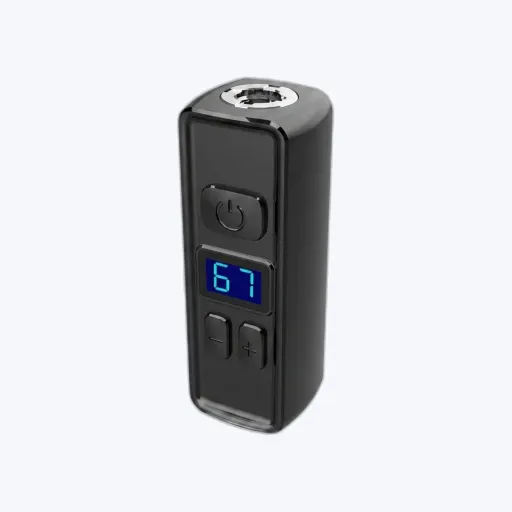
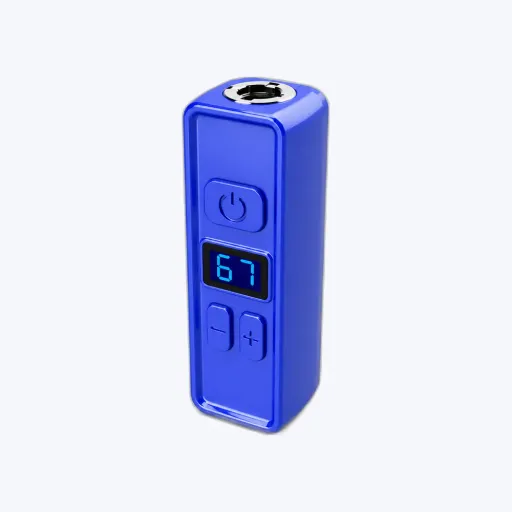
A variable voltage vape battery holds the voltage at the 510 contact at whatever the user selected, and lets the power fall where it falls. A variable wattage board does the opposite: the user asks for a power figure, the board measures the coil and adjusts voltage and current until that power is delivered.
The relationship between the two is Ohm's law. Power equals voltage squared divided by resistance. A voltage setting is only a power setting if you also know the resistance of the coil it is driving, which on a 510 platform you frequently do not, because the cartridge came from somewhere else.
Both descriptions appear loosely on spec sheets. A three-position slide switch is often labelled variable voltage even though it offers three fixed taps rather than continuous adjustment. Ask how many steps there are and what each one is set to, rather than accepting the category name.
| Variable voltage | Variable wattage | |
|---|---|---|
| What the board holds constant | The voltage at the coil | The power into the coil |
| What the user selects | A voltage, often in fixed steps | A wattage, often in fine increments |
| What is left to follow | Power and current, set by coil resistance | Voltage and current, computed by the board |
| Effect of changing coil resistance | Large. The same setting gives different power | Small. The board compensates for it |
| Behaviour as the cell discharges | Output drops unless the board regulates upward | Held until the cell can no longer supply it |
| Consistency across a mixed cartridge supply | Inconsistent between cartridge models | Consistent, within the board's range |
| What the setting means to a customer | Different things on different cartridges | The same thing on any cartridge |
| Board complexity and unit cost | Simpler and cheaper | More circuitry, higher cost |
| Diagnosing a bad draw | Harder. Coil resistance is a hidden variable | Easier. Power is known |
| Where it suits | A closed range where you specify the cartridge | An open 510 range with cartridges you do not control |
The table below applies the power equation to two coil resistances that CCELL publishes for its cartridge lines, 1.4 ohm on the TH2-EVO and M6T-EVO and 1.7 ohm on the EVOMAX builds, using voltage steps of the kind CCELL publishes on products such as the Tank, Voca Pro Max, Stylo and Palm Pro. The resistances and the voltage steps are their published figures. The wattages are arithmetic from those figures, not measurements.
| Voltage setting | Into a 1.4 ohm coil | Into a 1.7 ohm coil | Difference |
|---|---|---|---|
| 2.4 V | 4.1 W | 3.4 W | 0.7 W |
| 2.8 V | 5.6 W | 4.6 W | 1.0 W |
| 3.2 V | 7.3 W | 6.0 W | 1.3 W |
| 3.6 V | 9.3 W | 7.6 W | 1.7 W |
Two things follow. The same 3.2 V setting delivers 7.3 W into one cartridge and 6.0 W into another, a gap of about 20 percent that the customer experiences as a different device. And the gap widens as the setting rises, so the top setting is where a mixed cartridge supply causes the most complaints.
The arithmetic ignores board losses and treats the coil as a fixed resistor. Real coils change resistance as they heat, so measured power will sit below these figures. Use them to size the gap between cartridges, not as a specification.
On a 510 platform the battery and the cartridge often come from different suppliers, so the board has no way of knowing what it is driving unless it measures. A variable voltage board does not measure. It applies the voltage and the cartridge takes whatever current that implies.
That is workable when you control both halves. If you specify the cartridge and the battery together, you can pick voltage steps that land in the right power band for that coil and print sensible guidance on the box. It stops working the moment your cartridge is sold on its own, because the battery on the other end is a variable you never see. See cartridge coil resistance and battery voltage for cartridges.
Nextvapor describes its NEXGEN device with a stated power range of 2.8 W to 7.2 W and a tolerance of plus or minus 0.2 W, which is a wattage-controlled description rather than a voltage one. That is their published claim about their own product, not a figure we have tested.
A lithium cell does not hold 3.7 V. It starts above it and falls under load as it discharges. An unregulated board passes that sag straight to the coil, so the last draws of the day are weaker than the first. A regulated board, whether it regulates to a voltage or to a wattage, holds output until the cell can no longer support it and then cuts off.
This matters more than the voltage against wattage question for most buyers. Ask whether the board is regulated at all, and where its cut-off sits, before you ask what unit it displays. An unregulated three-step switch and a regulated three-step switch are described the same way in most catalogues.
Batteries carry documentation and registration duties that a cartridge does not. CE, RoHS, REACH and EU Battery Regulation documentation is available on request, WEEE support is available, and the market registrations remain yours. See compliance and battery safety and certification.
Trade guidance for B2B buyers, not legal advice. Empty hardware only, no cannabinoids and no e-liquid. B2B trade only, 18+ / 21+ per market. The buyer is responsible for the fill, for finished-product compliance and for product registration in their market.
Browse the range in the shop, full specs, trade pricing after a free account, and CE and compliance docs on request.
Browse the catalogueGive us the hardware, the quantity and the market. We reply with a price, a specification and a lead time. A request for a quote is not an order.
Empty hardware only. No cannabinoids and no e-liquid. We sell to companies only.