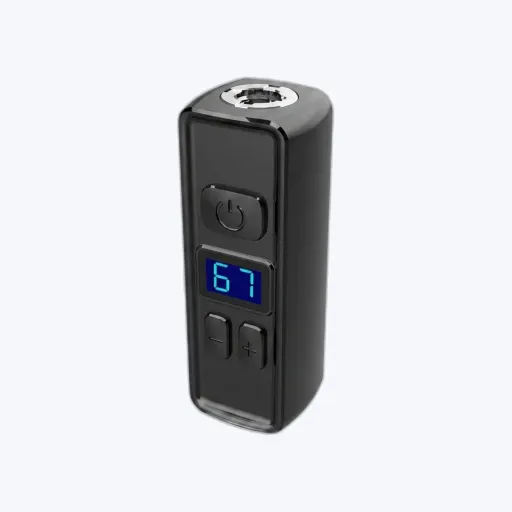
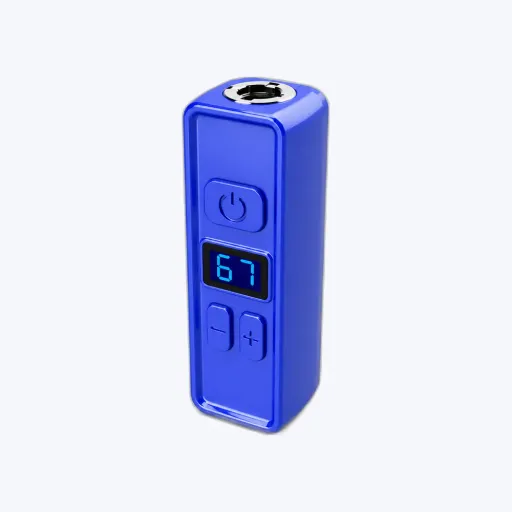
HardwareFor this job
By the Empty Vapes trade desk. Published 2026-08-21, last updated 2026-08-21. How we write these.
Capacity is the number buyers compare first and understand least. It says nothing about how hard a device hits. It says how many draws you get before a charge, and it costs you size, weight and charge time to raise it.
A milliamp-hour is a unit of charge. A cell rated 500 mAh can, under its rating conditions, deliver 500 mA for an hour or 1,000 mA for half an hour. It is a fuel tank measurement, and it says nothing about flow rate.
Flow rate is set elsewhere. Output voltage and coil resistance together fix the power at the coil, and power is what the customer experiences as strength. A 350 mAh battery at 3.2 V into a 1.4 ohm coil produces the same 7.3 W as a 900 mAh battery does. The bigger cell runs longer at that power. It does not run harder. If strength is your real question, matching a battery to a cartridge coil is the page, and variable voltage versus variable wattage covers how the board decides.
Two caveats. Rated capacity is nominal, measured under laboratory discharge conditions gentler than a vape draw. And no board runs a cell to zero, because deep discharge damages lithium cells, so a cut-off voltage strands part of the rating.
Do this arithmetic yourself. It is the only way to sanity-check a supplier claim.
The shorthand: a three-second draw at around 7 W costs roughly 2 mAh. Longer draws, hotter settings and lower-resistance coils cost more.
The figures below are arithmetic from the method above, not test results. Nothing was measured on a bench, and none of it is a specification of any product we sell.
| Nominal capacity | Draws per charge, on paper | Plan on, after derating | Bulk charge at 500 mA | What it costs you |
|---|---|---|---|---|
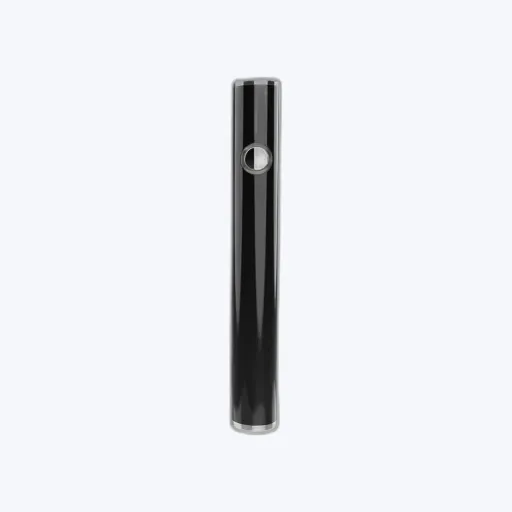
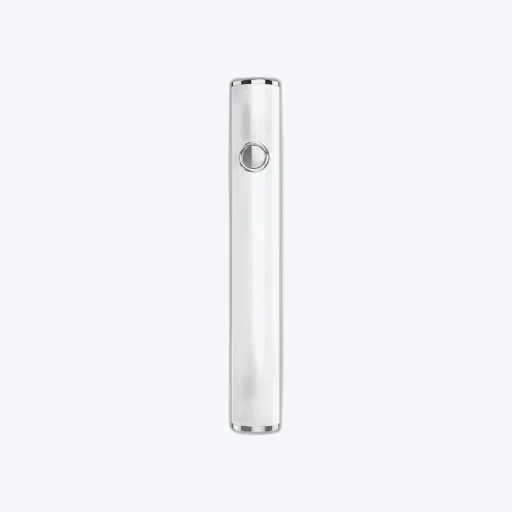
| 350 mAh | Around 180 | Around 120 | Around 42 minutes | Nothing. This is the slim pen form factor buyers expect |
| 500 mAh | Around 260 | Around 175 | Around 60 minutes | A noticeably thicker or longer body than a slim pen |
| 650 mAh | Around 340 | Around 230 | Around 78 minutes | Usually a box or oval body rather than a tube |
| 800 mAh | Around 420 | Around 280 | Around 96 minutes | Weight becomes obvious in the hand and in shipping |
| 900 mAh | Around 470 | Around 315 | Around 108 minutes | A device, not a pen. Higher cell cost and a longer charge |
A cross-check is worth doing. CCELL publish their Palm at 500 mAh with more than 250 puffs per charge, which sits close to the paper figure above rather than below it, a hint that the number is calculated rather than measured. The CCELL content pack we hold records that every performance figure across their published articles is self-reported, with no independent lab, test method or standard cited.
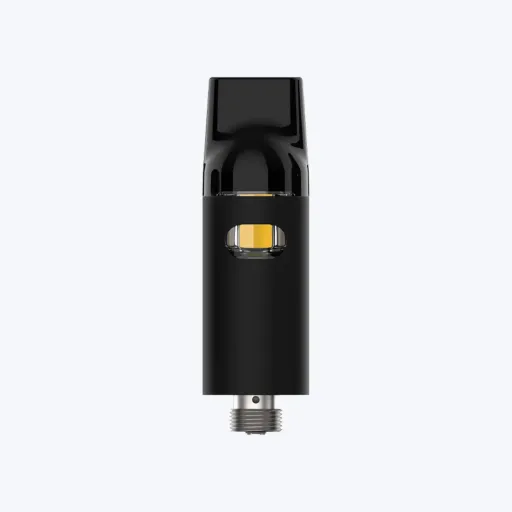
For a given cell chemistry, capacity is roughly proportional to cell volume, so doubling capacity roughly doubles the cell. That volume has to go somewhere, and a 510 battery cannot spread it freely, because the top of the device is committed to a threaded connector and a cartridge above it. The extra goes into length, which makes a pen unwieldy, or into width, which turns a pen into a box.
A design decision with commercial consequences. A slim pen fits a pocket and photographs well next to a cartridge. A box carries more charge and reads as more serious in the hand. Weight also shows up in shipping and packaging, since a heavier device wants more retention in the box.
For scale, the CCELL 510 battery products in our content pack sit roughly between 180 mAh and 550 mAh as published, with higher figures only where a charging dock is part of the product. The top of the 350 to 900 range is not typical of a slim pen. If a supplier offers 900 mAh in a pen-sized body, ask for the cell datasheet.
Charge time in the bulk phase is capacity divided by charge current. The tail, where the charger holds constant voltage and current falls away, adds to that and is not proportional. So a 500 mAh cell at 500 mA is about an hour to the tail, longer to a full charge.
The connector tells you nothing about this. USB-C is a connector, not a charge rate, and many small vape boards request well under 500 mA whatever they plug into. Ask for the charge current the board requests, and whether charge-temperature protection is fitted, because charging a lithium cell below freezing damages it and a device sold in northern Europe in winter will meet that condition. EU common charger rules also shape what a rechargeable device should carry, which USB-C and EU rules covers.
Work backwards from the cartridge, not from the number. A 0.5 ml cartridge consumed over a week does not need 900 mAh. A 1 ml cartridge a customer takes travelling might. If your buyers are retailers, ask what they get returned: dead on arrival points at a cell or charge-protection problem, dead by day two at capacity set too low.
Four things to request in writing. The cell rating and the cell manufacturer. The cut-off voltage the board uses. The charge current and whether charge-temperature protection is fitted. And the compliance file, because a lithium cell brings CE, RoHS, REACH and EU Battery Regulation obligations, plus UN38.3 before it can be transported. We supply that documentation on request with WEEE support, from around 500 units with no container minimum, and around six weeks for a branded run. See 510 batteries, the EU Battery Regulation guide and compliance.
Trade guidance for B2B buyers, not legal advice. We supply empty hardware only, with no cannabinoids and no e-liquid, B2B trade only, 18+ or 21+ according to your market. You are responsible for the fill, for finished-product compliance and for product registration in the markets you sell into.
Browse the range in the shop, full specs, trade pricing after a free account, and CE and compliance docs on request.
Browse the catalogueGive us the hardware, the quantity and the market. We reply with a price, a specification and a lead time. A request for a quote is not an order.
Empty hardware only. No cannabinoids and no e-liquid. We sell to companies only.