HardwareFor this job
By the Empty Vapes trade desk. Published 2026-08-21, last updated 2026-08-21. How we write these.
Two tanks in one body is an easy product to sell and a harder one to fill. The hardware decision is straightforward; its operational consequences are the part that gets underestimated.
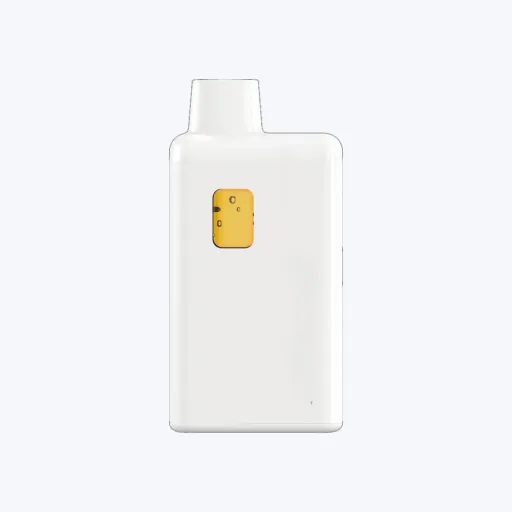
A dual chamber device holds two physically separate tanks in one shell. Each has its own heating element and its own intake. They share the battery, the control board and, in most designs, the mouthpiece. A control on the body decides which chamber is powered.
Nextvapor lists its Cobra platform as postless with two independent chambers, a digital screen with a real-time puff counter and a multi-function button handling voltage, preheat and mode switching. Its Gemini platform is also listed as dual chamber, with three flavour modes: left chamber, right chamber, and a blended centre position. Those are supplier descriptions of their own platforms rather than a general standard.
The distinction that matters is between two chambers and two coils. Nextvapor separately lists a Cobra Fusion with a dual ceramic coil in a single chamber. Two coils in one tank is a heating decision. Two chambers is a product decision, and only the second gives you two fills.
Three arrangements are common, and they are not equivalent.
Whichever it is, ask one question early: are the two airpaths separate all the way to the mouthpiece, or do they join below it. That detail decides how much flavour carries over, and it is rarely on the datasheet.
| Dimension | Single chamber | Dual chamber |
|---|---|---|
| Fill operations per unit | One | Two, with a changeover or purge between them |
| Heating elements | One coil to specify and verify | Two, which may not be matched in resistance unless you ask |
| Moving parts | None beyond the charge port, where fitted | A selector switch or an extra control mode |
| Batch records per unit | One oil, one lot code | Two oils, two lot codes tied to one serial |
| QC time per sampled unit | One airflow check, one leak test | Both chambers separately, plus the switch and any blended mode |
| Label content | One composition to declare | Two compositions plus the selector to explain |
| Idle time before first use | Short; the tank is used from day one | One chamber can sit filled and unused for weeks |
| Unit cost of hardware | Lower, and the widest choice of formats | Higher, with fewer platforms available |
| Consumer proposition | Simple to explain on a shelf | Two flavours or strengths in one purchase |
The unused chamber. If a user favours one side, the other sits filled with an unheated coil through weeks of temperature cycles in a pocket and a car. Oil settles, separates and migrates. The first draw from that side produces the complaint, long after the batch was signed off.
Carryover in the shared airpath. The liquids do not mix if the chambers are sealed, but condensate in a shared mouthpiece does, so a strong flavour on one side reads as contamination of the other. That is a design characteristic rather than a defect, and it still generates returns.
The switch itself. A mechanical selector is the highest-wear part on the device. Ask for a cycle figure, and treat a switch with no stated cycle life as an unknown rather than a pass.
Asymmetric coils. Two elements in one device do not have to be identical, and if their resistance differs the sides deliver differently at the same voltage. Specify resistance and tolerance for both, as covered in coil resistance.
Leaks doubled. Two tanks means two sets of seals and two intakes in one shell, so the potential leak paths roughly double. The mechanisms are covered in disposable filling problems.
Every unit passes the fill station twice, and between the passes the line either changes over or purges. That is where the cost sits, not in the oil. If the two fills are different products, the changeover is a cleaning operation with its own validation, repeated every batch.
Curing doubles too. Both cores need to wick before capping, and a device capped with one dry coil ships a burnt first puff on that side. See cure time and how to fill a disposable.
Traceability is the third cost and the one with compliance weight. One serial number now carries two oil lot codes, and if you cannot tie both to the unit, a recall on one oil becomes a recall on every device that might contain it. Registration duties do not change with the format and sit with whoever places the finished product on the market. See compliance.
Stock empty disposables start from around 500 units with no container minimum, and branded runs take about 15 days, which is enough to fill and age a small dual chamber batch first. CE, RoHS, REACH and EU Battery Regulation documentation is available on request and WEEE support is available.
Trade guidance for B2B buyers, not legal advice. We sell empty hardware only; you are responsible for the fill and for finished-product compliance in your market.
Browse the range in the shop, full specs, trade pricing after a free account, and CE and compliance docs on request.
Browse the catalogueGive us the hardware, the quantity and the market. We reply with a price, a specification and a lead time. A request for a quote is not an order.
Empty hardware only. No cannabinoids and no e-liquid. We sell to companies only.