HardwareFor this job
By the Empty Vapes trade desk. Published 2026-08-20, last updated 2026-08-20. How we write these.
Doubling the tank does not double the rest of the device. Battery, coil, wick, packaging and transport paperwork all move, and they do not move by the same factor.
A 2 g disposable holds twice the oil of a 1 g device. Very little else scales by two. The coil is often the same part, the airpath is often the same diameter, and the cell usually grows by less than half. That mismatch is where most 2 g product problems start, so it is worth walking each subsystem before you agree a spec with a supplier.
Cell capacity is quoted in milliamp hours. Oil capacity is quoted in grams. There is no fixed ratio between them, because the energy per gram depends on coil resistance, the voltage the device runs at, and how long a typical draw lasts. What is fixed is the direction of the problem. Double the oil, leave the cell alone, and the device goes flat with oil still in the tank.
There are two answers. Fit a larger cell, which makes the device thicker and heavier. Or make the device rechargeable, normally over USB-C. Rechargeable is the common answer because it separates the two capacities: the cell only has to cover a day of use, not the whole tank.
Ask a supplier for four figures before you commit: cell capacity in mAh, coil resistance in ohms, charge port type, and whether the device supports pass-through charging. Those decide whether a customer ever reaches the bottom of the tank. The same arithmetic applies to a two-part kit; see matching a 510 battery to a cartridge coil.
A coil in a 2 g device vaporises twice as much oil across the product life as the same coil in a 1 g device. Nothing about the coil changed. Total heat cycles roughly double, the porous ceramic sees twice the throughput, and any gradual drift in flavour or draw that was invisible at 1 g becomes visible in the second half of a 2 g tank.
Wicking is the other half of it. A deeper tank means the oil column above the intake is taller when the device is full, and the remaining oil sits further from the intake when it is nearly empty. Thick oils feel both ends of that range. If you are filling rosin or a high viscosity distillate, confirm the intake size rather than assuming the 1 g part carries over unchanged.
A larger volume separates more visibly and takes longer to reach equilibrium. Two effects matter to a trade buyer. First, layering in the tank is easy to see through the window after weeks in a warehouse, and customers read it as a defect whether or not it affects performance. Second, the air above the oil is part of the system. Air expands when ambient pressure drops or temperature rises, and it presses on the oil. A device flown as air freight or left in a hot van has a pressure differential across its seals, and a bigger tank holds more air to do the pressing.
The controls are fill temperature, headroom and rest time before capping. Those are covered in the disposable filling guide and in more depth in the four filling failure modes.
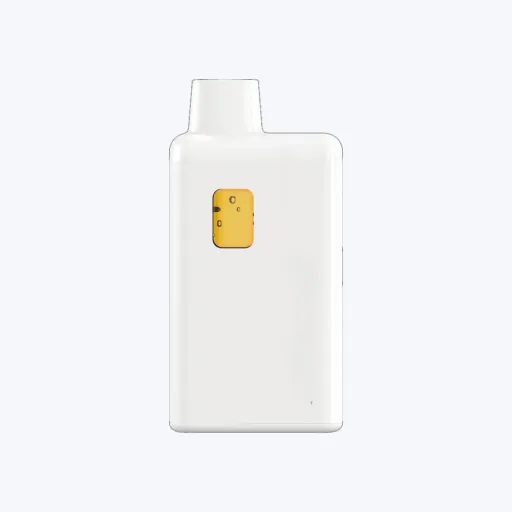
A 2 g device is larger in at least one dimension. Any box, blister or insert tooled around your 1 g unit will not take it. If you run both formats, budget for two sets of packaging tooling rather than one, and settle the artwork area early, because the printable face may change shape and not only size.
On transport, the unit is heavier and the cell is larger. Lithium cells travel under their own rules, and the paperwork follows the cell rather than the oil. Request the battery test documentation at quote stage rather than after the order; see shipping lithium vape batteries into the EU.
Market rules are a separate question again. Fill volume limits, labelling and product registration are set per market and per category, and a 2 g device is not automatically allowed where a 1 g device is. Read compliance and confirm the position for each country you sell into with your own advisor.
| 1 g device | 2 g device | |
|---|---|---|
| Battery strategy | Single charge often covers the tank | Recharge port or a larger cell, usually both considered |
| Coil workload | Baseline heat cycles | Roughly double the throughput on the same part |
| Wick demand | Short oil column | Taller column full, longer reach when nearly empty |
| Headroom and air | Less air above the oil | More air, so more pressure movement in transit |
| Body size | Baseline footprint | Larger in at least one dimension |
| Packaging tooling | Existing tooling | New tooling, new artwork area |
| Shipping paperwork | Lithium documentation required | Lithium documentation required, larger cell |
Empty Vapes supplies empty disposables as hardware only, with no cannabinoids and no e-liquid. MOQ starts from around 500 units, branded runs take about 15 days, and CE, RoHS, REACH and EU Battery Regulation documentation is available on request.
Trade guidance for B2B buyers, not legal advice. We sell empty hardware only; you are responsible for the fill and for finished-product compliance in your market.
Browse the range in the shop, full specs, trade pricing after a free account, and CE and compliance docs on request.
Browse the catalogueGive us the hardware, the quantity and the market. We reply with a price, a specification and a lead time. A request for a quote is not an order.
Empty hardware only. No cannabinoids and no e-liquid. We sell to companies only.